Snow Gum (Eucalyptus pauciflora)
$24.95
Ships to NSW, ACT, VIC and QLD by tracked courier. We cannot send this tree to SA, Tasmania, WA or the NT.
- Exceptionally Frost Hardy
- White, Grey and Cream Patchwork Bark
- Grown On at Mittagong
- Dispatched from Mittagong, NSW
Out of stock
This product is currently sold out.
No worries! Enter your email, and we'll let you know as soon as it's back in stock.
 Secure Payments


The Tree of the Australian High Country
The Snow Gum (Eucalyptus pauciflora) is the tree of the south-eastern high country, and it is native to our own Southern Highlands. People plant it for its bark: smooth, shedding to a patchwork of white, grey, cream and soft green over a trunk that twists and leans. Ours were raised by our growers in Tasmania and grown on here at Mittagong, where we potted them up into 180mm pots and held them back to put on size. It is not a fast tree and it is not a tree for humid districts, and we would rather tell you that now. We dispatch from Mittagong in the NSW Southern Highlands, a region free of key plant pests.
Size: 180mm pot, approx. 55 to 70cm tall
Height: Measured from the base of the pot to the tip of the leader
Growth Habit: Slow to moderate and sculptural, with a twisting, leaning trunk; about 10 to 20m in a garden, smaller on cold, exposed sites
Bark: Smooth, shedding each year to a patchwork of white, grey, cream and soft green
Climate: Native to the Southern Highlands. Thrives in cool districts with frost, wind and moving air; not for warm, humid areas, where it is prone to fungal disease
Position and Soil: Full sun, a lightly exposed spot and a cool root run. Best in sandy, mineral soils that drain freely; heavy clay must be broken up first
Our Stock: The straight species, raised by our growers in Tasmania and grown on outdoors at Mittagong
Style: A sculptural specimen, screen or grove for a cold, open garden; also a bonsai subject
APPROXIMATE ACTUAL PLANT SIZE: 55 TO 70CM TALL (180MM POT)*
*Heights are measured from the base of the pot to the tip of the leader. As these are living trees, dispatched sizes may vary slightly with seasonal growth, but every specimen carries an established root system ready for its next stage of development.
Walk the high country of south-eastern Australia in winter and this is the tree standing in the snow. The Snow Gum (Eucalyptus pauciflora) is the eucalypt that climbs highest, forming the tree line on the Australian Alps and ringing the frost hollows of the tablelands, where cold air pools and little else of its size survives. It is also a local: it grows wild here in the NSW Southern Highlands, which is one reason we know it well.
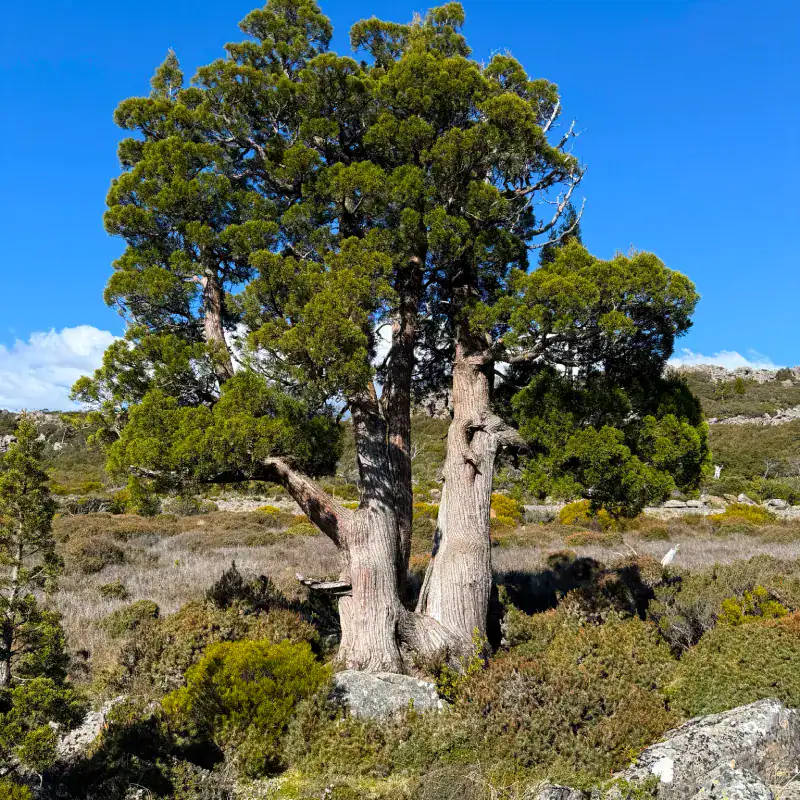
Its bark is the reason most people plant it. It is smooth, and each year it sheds in ribbons to show a fresh patchwork of white, grey, cream and soft green, often marked with the fine scribbles left by moth larvae tunnelling beneath the old bark. The trunk underneath twists and leans, and old trees on exposed ridges grow low and many-stemmed, bent by wind and snow, so no two take the same shape. Wet from rain or lit by low winter sun, a mature Snow Gum is one of the most beautiful trunks in the Australian bush.
Look closely and the details are just as good. The leaves are thick, glossy and lance-shaped, blue-green to grey-green, with veins that run almost parallel along the leaf, which is unusual in a gum. White flowers cover the tree from late spring into summer and draw bees and honeyeaters. The name is a botanical curiosity: pauciflora means “few-flowered”, and the tree is anything but.
It helps to know what this tree is not. It is not fast: it is slow to moderate, and that is part of its appeal. It is not a tree for humid, subtropical districts, where it is prone to fungal problems. And it is not symmetrical; it grows with character, not to a pattern. What it is: one of the hardiest eucalypts there is, at home in hard frost, snow and wind, happy in poor, sandy and mineral soils, and able to reshoot from its base after fire.
If you want to buy a Snow Gum in Australia, ours is the straight species in a 180mm pot, at about 55 to 70cm: big enough to have presence the day it is planted, and still young enough to establish quickly, because gums settle best when they go into the ground young.
- Patchwork Bark: Smooth bark sheds to white, grey, cream and soft green, often marked with insect scribbles.
- Built for Cold: It forms the tree line on the Australian Alps, and takes hard frost, snow and wind.
- Thrives in Poor, Dry Ground: At its best in sandy, gravelly, mineral soils, and very drought-tolerant once established.
- Comes Back From Fire: It reshoots from a woody lignotuber at its base after fire or severe damage.
Plant a High-Country Garden
How big does a Snow Gum grow, and how fast?
How much cold can it take?
Will it grow where I live?
Where in the garden should I plant it?
My soil is heavy clay. Can I still plant one?
Is this the alpine Snow Gum from the ski fields?
Can I buy a larger tree, or several for a project?
When does the bark shed, and what are the scribbles?
Does it come back after fire, and can I prune it hard?
Can I grow it in a pot or as a bonsai?
Detailed Description and Specs
The Snow Gum (Eucalyptus pauciflora), also known as White Sally or Cabbage Gum, is native to south-eastern Australia, from the northern tablelands of New South Wales south through the ACT and Victoria to Tasmania. It grows from cold valley floors to the upper limit of trees on the mainland, and it is the tree that rings the frost hollows of the high plains, standing at the edge of ground too cold for any other eucalypt. It grows naturally in our own district too, on the higher, more exposed country of the Southern Highlands.
It is a variable species, which is part of its interest. The tree on this page is the straight species, Eucalyptus pauciflora. At the highest elevations it is represented by the alpine Snow Gum, subspecies niphophila, the low, gnarled tree of the ski fields. Subspecies debeuzevillei, the Jounama Snow Gum, carries larger, more silvery leaves and buds, and there is a compact garden selection sold as ‘Little Snowman’. We sell the straight species, and all three of those forms can be sourced through our grower network by special order.
The bark is smooth and is shed each year, usually from late summer into autumn, peeling in ribbons to leave fresh colour beneath: white, grey, cream, soft green and sometimes flushes of pink or olive that fade as the season goes on. The scribbles on older trunks are the old feeding tunnels of moth larvae, exposed when the bark above them falls away. Beneath the ground the tree carries a lignotuber, a woody swelling at the base of the trunk packed with dormant buds. After fire, heavy snow damage or hard pruning it reshoots from there, which is how the same tree can stand on a mountainside for generations and why so many old Snow Gums have several trunks.
Ours were raised by our growers in Tasmania and have been grown on at Mittagong, where we potted them up into 180mm pots and held them back to put on size and root. They have lived outdoors here through Southern Highlands frost, wind and summer, so they arrive already hardened to mainland conditions. At about 55 to 70cm they are well past the fragile tube stage. If your project calls for something larger, we can usually source Snow Gums in 250mm and 330mm pots and as 35L, 45L and 100L specimens through our network in Tasmania, Victoria and New South Wales; ask us through our Special Orders page. We dispatch from Mittagong in the NSW Southern Highlands, a region free of key plant pests.
Here’s why we think you’ll love the Snow Gum:
- Species: Eucalyptus pauciflora (Snow Gum / White Sally / Cabbage Gum); the straight species
- Provenance: Native to the alps and tablelands of south-eastern Australia, including the Southern Highlands; raised by our growers in Tasmania and grown on at Mittagong
- Size: 180mm pot, approx. 55 to 70cm, measured from the base of the pot to the tip of the leader
- Growth Rate: Slow to moderate, with a naturally twisting, leaning habit; about 10 to 20m in a garden, smaller on cold, exposed sites
- Foliage and Flowers: Thick, glossy, blue-green to grey-green leaves with near-parallel veins; white flowers from late spring into summer
- Bark: Smooth, shedding each year to a patchwork of white, grey, cream and soft green, often with insect scribbles
- Best For: A sculptural specimen, a screen or grove in a cold, open garden, or a bonsai subject
Care and Planting Guide
The Snow Gum is a mountain tree. Give it sun, moving air, drainage and a cool root run, and it asks for very little else. Most failures come from the opposite: still, humid air, or water sitting around the roots.
- When It Arrives: Unpack it straight away and give it a good drink. Stand it somewhere bright but sheltered from sun and wind for at least four days, then move it into the open over the following week so it adjusts gradually to your conditions before you plant.
- Where to Plant: Full sun and an open position with air moving through it. Even here in the Southern Highlands, where it grows wild, it does best in a spot that is lightly exposed, not tucked into a sheltered corner. Allow for a tree of 10 to 20 metres and plant it well clear of buildings, pipes and power lines.
- Soil & Drainage: It is at its best in sandy, gravelly and mineral soils that drain freely, and it copes with poor ground that defeats other trees. It will grow in clay, but heavy clay needs breaking up first: dig a wide, shallow area, work in gypsum and coarse material, and plant on a slight mound so water runs away from the trunk. It prefers neutral to slightly acidic soil.
- Planting: Plant in autumn or early spring where you can, so the roots establish in cool, moist soil. Dig the hole twice as wide as the pot and no deeper, set the tree at the level it sat in the pot, and disturb the root ball as little as possible; gums resent root damage. Water it in well.
- A Cool Root Run: Snow Gums like their roots cool. Mulch with a coarse, open material such as wood chip or gravel, 5 to 7cm deep, and keep it pulled back from the trunk. Avoid fine, moisture-holding mulches packed against the stem.
- Watering: Water regularly through its first two summers while the roots go down, deeply and then letting the soil dry a little between drinks. Once established it is very drought-tolerant and needs watering only in long dry spells, though it grows faster with regular water.
- Frost and Wind While Young: It is built for heavy frost and exposed, windy sites, but give a newly planted tree some protection from the worst wind for its first season or two. If you stake it, stake low and loosely and take the stake away after the first year, so the trunk strengthens by moving. Once established it is quite happy in the open.
- Know Your Climate: It thrives in the Southern Highlands, the Blue Mountains, the central and southern tablelands, the ACT, cool-climate Victoria and Tasmania. In warm, humid districts, including coastal Sydney, the northern New South Wales coast and Queensland, it is prone to fungal disease and we do not recommend it.
- Feeding: Very little. A seaweed tonic at planting helps it settle. If you feed at all, use a low-phosphorus fertiliser made for Australian natives, lightly, in spring.
- Pruning & Shaping: None is needed, and the tree shapes itself with more character than secateurs can. Remove dead or damaged branches in late winter or early spring, and thin a very dense crown lightly to let in light and air. For a multi-stemmed tree like those of the high ridges, an established Snow Gum can be cut back hard near the base in late winter and will reshoot from its lignotuber.
- In a Pot: It can live in a large container for some years, and it is a rewarding bonsai subject. Use a free-draining mix, pot up one size at a time, and never let the pot sit in a saucer of water. Our journal has a full guide to growing media.
Shipping and Delivery
How your tree travels
Each tree is hand-selected, watered thoroughly and given a seaweed tonic before it is packed, then sent in its own pot in a carton sized to fit it. It travels by tracked courier, and you receive tracking updates by email, and by SMS if you opt in.
When we dispatch
We pack and send early in the week, Monday to Wednesday, so plants are not sitting in a depot over a weekend. In the warmer months we send on Monday and Tuesday only, and we will not pack on a day when it is above about 27°C here in the Southern Highlands. If heat at either end, or a known disruption to the courier network, would put your tree at risk, we hold it for a few days and let you know. Unpack and water it the day it arrives.
Eastern States (NSW, ACT, VIC, QLD)
Eligible for standard shipping via our secure specialist plant freight network. We dispatch from Mittagong in the NSW Southern Highlands, in a region free of key plant pests — which lets us send most species directly to the Eastern States and the ACT without additional treatment. If you are ordering for a warm, humid district, please read the climate notes in the Care and Planting Guide first.
South Australia, Tasmania, Western Australia & Northern Territory (SA, TAS, WA & NT)
We cannot send this tree to South Australia, Tasmania, Western Australia or the Northern Territory. Eucalypts belong to the myrtle family (Myrtaceae), and those states restrict the entry of myrtle-family plants.
Larger trees
Snow Gums in 250mm and 330mm pots, and 35L, 45L and 100L specimens, can usually be sourced for delivery within the Eastern States. Tell us what you are planning through our Special Orders page.
If something is not right
It is rare, but if your tree arrives damaged, contact us straight away with a photo and we will sort it out. Our Returns and Refund Policy has the detail.
Plant a Piece of the High Country
Shop More TreesRelated products