


Tulip Tree (Liriodendron tulipifera)
$59.95
Potted stock available late September 2026. Direct dispatch to Eastern States & ACT. TAS via Plant Concierge. Unable to ship to WA or NT.
- Potted — Late September
- 2nd Year Grade — Grown On
- Fast-Growing Architectural Frame
- Grown On At Mittagong
Out of stock
This product is currently sold out.
No worries! Enter your email, and we'll let you know as soon as it's back in stock.
 Secure Payments


One Allocation. No Restock.
Liriodendron tulipifera—the Tulip Tree—is one of the most architecturally dramatic and imposing deciduous trees available in temperate horticulture. Native to the tall forests of eastern North America, it is renowned for three extraordinary attributes unmatched by any other species in this collection: spectacular cup-shaped, yellow-green flowers banded with orange; uniquely truncated leaves identifiable at a glance; and a pure, luminous golden-yellow autumn display. As one of the fastest-growing hardwoods in cultivation, it rapidly develops a majestic canopy, demanding space in grand estates, parks, or large rural properties. Field-grown to a highly developed 2nd-year grade, lifted at full dormancy and potted on here at Mittagong, it is genuinely rare to secure this species at this grade in Australia. A strictly limited allocation, and a fleeting opportunity for landscape designers and serious collectors.
Pot Size: 200mm
Est. Plant Height: Approx. 100–110cm tall, measured from the base of the pot to the tip of the leader
Mature Size: 15–25m in Australian cultivation (a very large canopy tree)
Growth Habit: Fast-growing, tall forest dominant with a strong architectural frame
Style: Large Estates / Parkland Plantings / Prestige Landscape Design
APPROXIMATE ACTUAL PLANT SIZE: 100–110CM TALL (IN A 200MM POT)*
*Heights are measured from the base of the pot to the tip of the leader. Dispatched sizes may vary slightly with seasonal growth, but every specimen carries an established root system ready for its next stage of development.
The Liriodendron tulipifera is a true giant of eastern North America and a masterpiece of the Magnoliaceae family. While it is sometimes confusingly referred to as the “Tulip Poplar,” it has no relation to poplars whatsoever. Instead, it is a grand, fast-growing hardwood that commands attention through three completely unique botanical features.
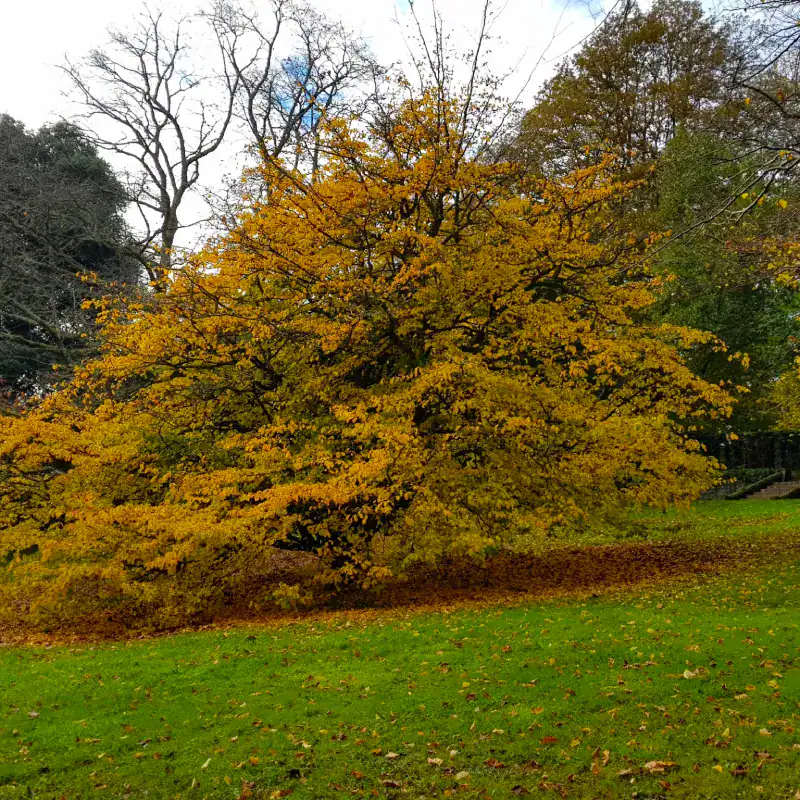
The first is its foliage: the leaves are uniquely truncated, appearing as though their tips have been neatly clipped off with scissors, making the tree instantly identifiable from 50 metres away. In autumn, these leaves transition into a pure, luminous golden-yellow — devoid of the muddy oranges or reds found in other deciduous species — creating a clean, brilliant glow against a blue autumn sky. Finally, for the patient custodian, the tree rewards maturity (typically after 10–15 years) with extraordinary cup-shaped flowers. Measuring 5–6cm across, these yellow-green blooms are beautifully banded with orange at the base, genuinely resembling tulips sitting high in the canopy. Due to its ultimate size (15–25m), it requires deep, moist soil and significant space to thrive, making it the ultimate prestige planting for large landscapes.
These specimens were field-grown to 2nd-year grade, lifted at full dormancy and potted on here at Mittagong. By release they will carry a full season of root establishment — the structural advantage of field production, without the narrow planting window that bare root demands.
- Uniquely Truncated Leaves: The fascinating leaf shape features a distinctively clipped tip and two lateral lobes. There is no other deciduous foliage quite like it.
- Luminous Autumn Gold: Produces a pure, unblemished golden-yellow autumn display. A brilliant contrast tree when planted near deep reds or burgundies.
- Tulip-Like Flowers: At maturity (10-15 years), the canopy erupts in spectacular 5-6cm cup-shaped yellow-green flowers with striking orange basal bands.
- Fast Architectural Growth: One of the fastest-growing hardwoods in cultivation, rapidly developing a commanding structural presence in large landscapes.
Complete Your Collection
Tulip Tree (Liriodendron tulipifera)
Persian Ironwood (Parrotia persica)

Giant Redwood (Sequoiadendron giganteum)
$37.95 – $94.95Price range: $37.95 through $94.95
Wollemi Pine (Wollemia nobilis)
Trusted by Gardeners Like You
Is this tree related to a Poplar?
Will my tree flower immediately?
Is this suitable for a standard suburban backyard?
Why do TAS, WA, and NT orders require special contact before ordering?
What's the difference between the bare root and potted stock?
What condition will my tree arrive in?
Detailed Description and Specs
The Tulip Tree (Liriodendron tulipifera) is a monumental deciduous hardwood native to eastern North America, where it dominates the tall forest canopy. It belongs to the Magnoliaceae family, setting it completely apart from the poplars it is sometimes erroneously named after.
The tree is defined by three exceptional traits. Its foliage is highly unusual, featuring a truncated tip that appears deliberately clipped, flanked by distinct lateral lobes. In autumn, this foliage turns a pure, luminous golden-yellow, free of muddy undertones. In late spring to early summer, mature specimens (10–15 years +) produce magnificent 5–6cm cup-shaped flowers. These blooms feature pale yellow-green petals strikingly banded with vivid orange at the base, closely resembling a garden tulip. As one of the fastest-growing hardwoods in cultivation, it rapidly establishes a tall, straight trunk and a significant architectural canopy. Our allocation was field-grown to 2nd-year grade, lifted at full dormancy and potted on at Mittagong to establish through spring. We dispatch from Mittagong in the NSW Southern Highlands, a region free of key plant pests, allowing direct delivery to the Eastern States and the ACT without additional treatment.
- Species: Liriodendron tulipifera (Tulip Tree)
- Family: Magnoliaceae
- Foliage: Uniquely truncated (flat-tipped) bright green leaves.
- Autumn Colour: Pure, luminous golden-yellow.
- Flowers: Cup-shaped, yellow-green with orange banding (appears at maturity).
- Best For: Expansive landscapes, rural acreages, and prestige estate plantings.
Care and Planting Guide
The Tulip Tree is a fast-growing, substantial species that thrives when its spatial and soil requirements are respected from the beginning.
- Sunlight & Location: Requires full sun for the best growth habit and autumn colour. It must be planted in an open position with ample room to accommodate its ultimate height (15–25m) and broad canopy.
- Soil & Drainage: Prefers deep, rich, moist, and well-draining loam. It is highly intolerant of heavy, compacted, or waterlogged clay soils. Incorporate generous amounts of organic matter at planting.
- Watering: Consistent moisture is critical, especially during its rapid early growth phases and hot summer months. It does not tolerate prolonged, severe drought well; deep, regular watering will ensure a robust canopy.
- Climate: Performs exceptionally well in cool to warm temperate climates (Southern Highlands, ACT, VIC, elevated NSW/SA). It requires distinct seasons and is not suited to coastal humid subtropical or tropical environments. For complete planting and establishment guidance, see our full guide in the Journal: How To Plant Bare Root Trees In Australia.
Shipping and Delivery
Potted Stock — Available Late September 2026
These trees are being grown on at our Mittagong nursery and will be released in late September, established and ready to plant. Join the waitlist above, and you will be notified the moment stock goes live.
Eastern States (NSW, ACT, VIC, QLD, SA)
Eligible for standard shipping via our secure specialist plant freight network. We dispatch from Mittagong in the NSW Southern Highlands, in a region free of key plant pests — which lets us send most species directly to the Eastern States and the ACT without additional treatment.
Tasmania (TAS)
Tasmanian orders are handled through our Plant Concierge, which coordinates all Bass Strait biosecurity treatment and inspection via a licensed specialist before your plants are forwarded to you. Start your enquiry at Plant Concierge.
Western Australia & Northern Territory (WA & NT)
We are unable to ship this species to Western Australia or the Northern Territory. At 100–110cm tall, these specimens require a carton longer than the maximum permitted on the quarantine pathway to those states. If you are in WA or NT, we can help you identify a suitable alternative from our range — start an enquiry at Plant Concierge.
Lord Howe Island & Norfolk Island
We are unable to ship to Lord Howe Island or Norfolk Island under any circumstances.
Join the Waitlist For Your Allocation
Shop More TreesRelated products

Blue Spruce Potted Christmas Tree
$139.00 – $249.00Price range: $139.00 through $249.00
Douglas Fir Potted Christmas Tree
$99.00 – $219.00Price range: $99.00 through $219.00
Fraser Fir (Abies fraseri)
$54.95