The Tree Before the Bonsai

SPECIES GUIDES · 2026 · SHANNON PETERS
The Tree Before the Bonsai
Japanese Black Pine in Australia — what the tree actually is, how to read good material, and where to learn to work it.
Before it was ever a bonsai subject, Pinus thunbergii was a tree that held sand together. In Japan it is kuro-matsu, the black pine of the coast, planted in long shelter belts to fix dunes and break the wind coming off the Pacific. Bean records that E. H. Wilson saw large specimens on the shore in Shikoku whose trunks were washed by the waves at flood tides and in high seas (Trees and Shrubs Online). Left alone it makes a tree of 30–40 metres.
Almost nobody in Australia meets it that way. Most people meet it in a 200mm pot, as bonsai material, and everything they read about it afterwards is written for a garden in California or a workshop in Saitama. That gap is the reason for this article.
What follows is about the tree itself — how to recognise it, how to read whether a young plant is good material, what the difference between seed-grown and grafted stock actually means, and how its growth cycle sits in a southern-hemisphere year. It is not a guide to styling one. That distinction matters enough that it gets its own section, next.
What This Article Is, and Is Not
I grow and propagate rare and cool-climate species. I can tell you what a plant is, where it came from, whether the genetics are sound, how it will behave in an Australian climate, and whether a given specimen is worth your money. That is my work and I will state it plainly.
I am not a bonsai practitioner. I have never styled a show tree, I do not run a development schedule, and I am not going to pretend otherwise in order to sell you a pine. Where this article covers technique — decandling in particular — it explains the botany underneath it and then cites practitioners who actually do the work. For the work itself, the right people are in a club, and the last section of this article tells you where to find them.
Where the knowledge in this article comes from: the botany, identification and climate material is drawn from published dendrological and government sources, all listed at the end. The timing and technique material is attributed to named bonsai practitioners and is theirs, not mine. Where I describe something I have seen in my own stock, I say so explicitly and mark it as observation rather than established fact.
Reading the Tree
Japanese Black Pine is mislabelled often enough in the Australian trade that it is worth knowing how to check for yourself. There are three tells, and the first is the best.
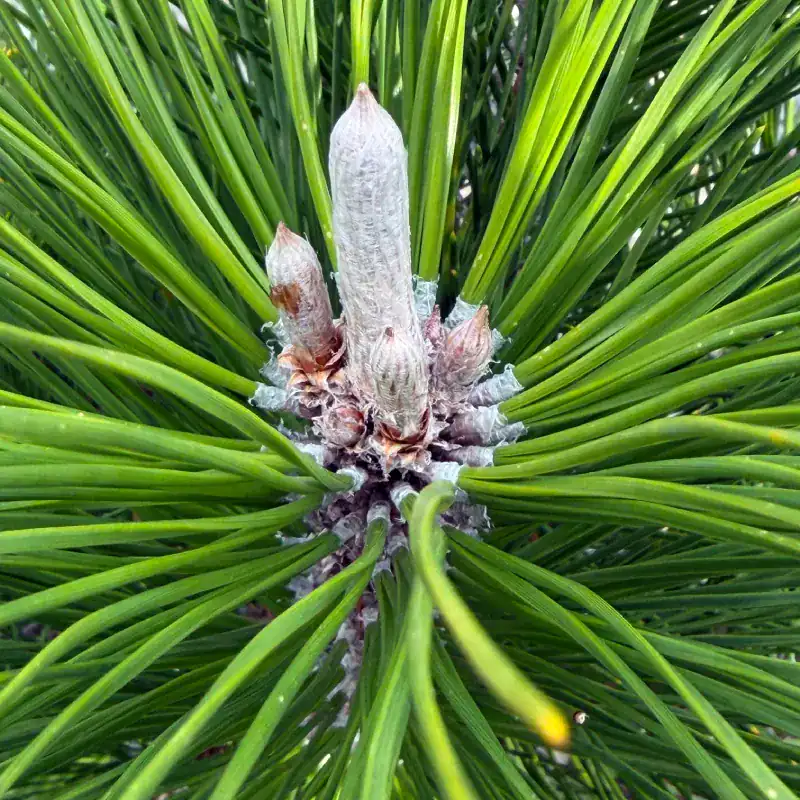
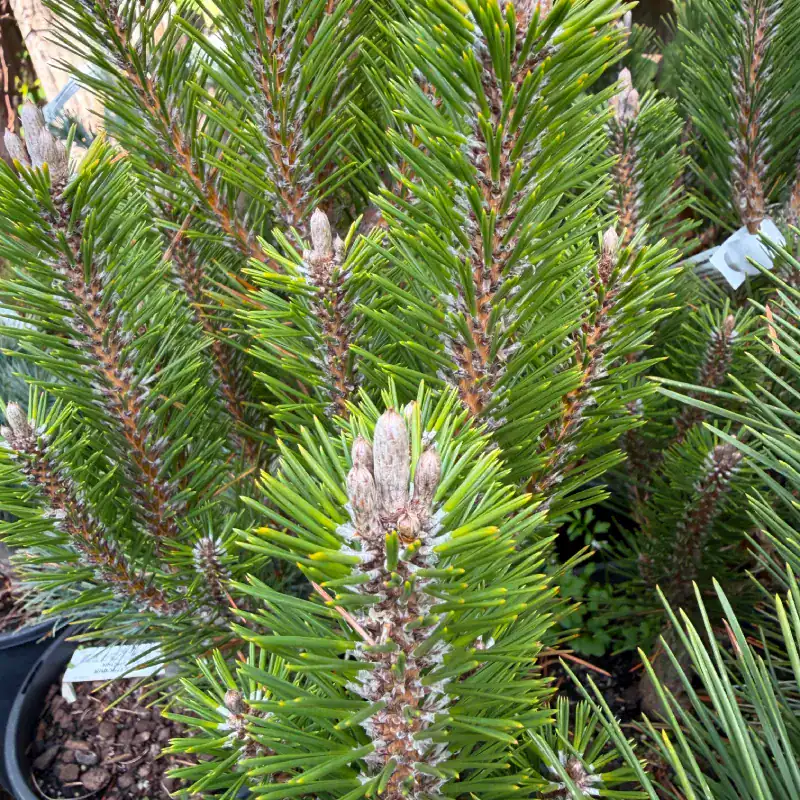
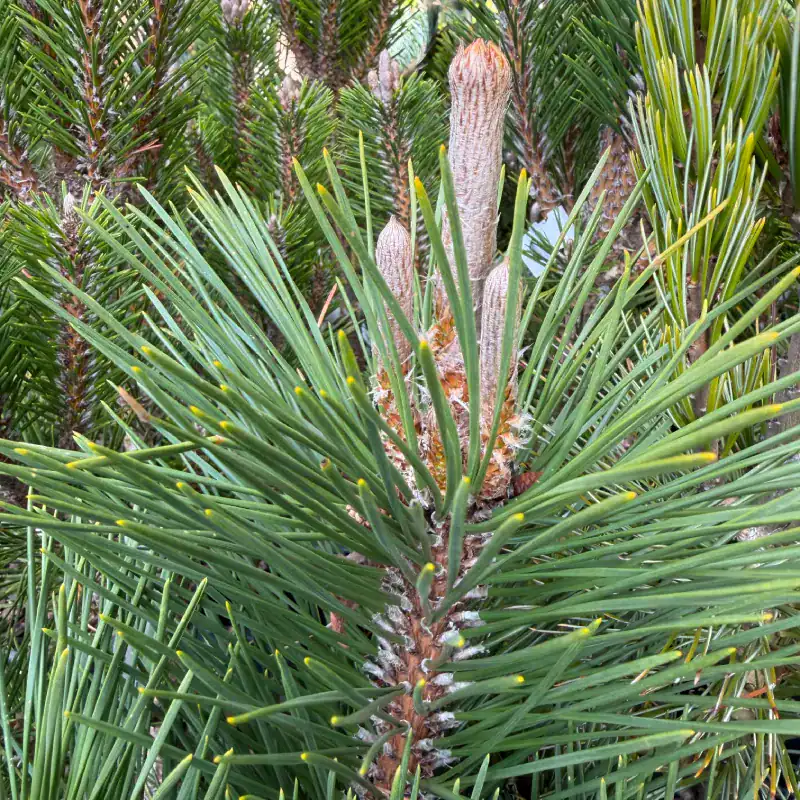
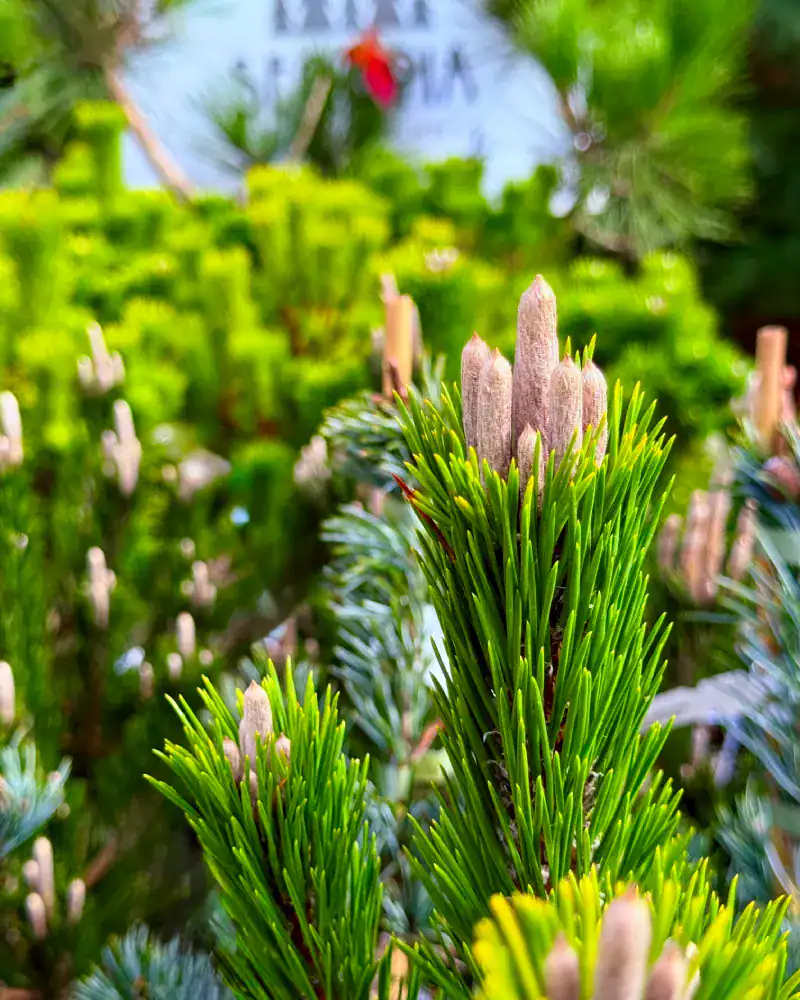
The new shoots are woolly. Young extending shoots carry a dense whitish felt — a tomentum — that the conifer taxonomist Aljos Farjon’s reference database describes as highly distinctive among pines (conifers.org). Run a thumb along a new shoot. If it is smooth and light brown, look harder.
The winter buds are silvery-white and not sticky. Bean describes them as egg-shaped to almost globose, not resinous, with pale brown scales edged in conspicuous whitish threads. This is the feature that separates it from Austrian Pine, its closest look-alike: the two are allied, but thunbergii is distinguished by those broad, grey-white buds and by shorter, stiffer leaves (Trees and Shrubs Online).
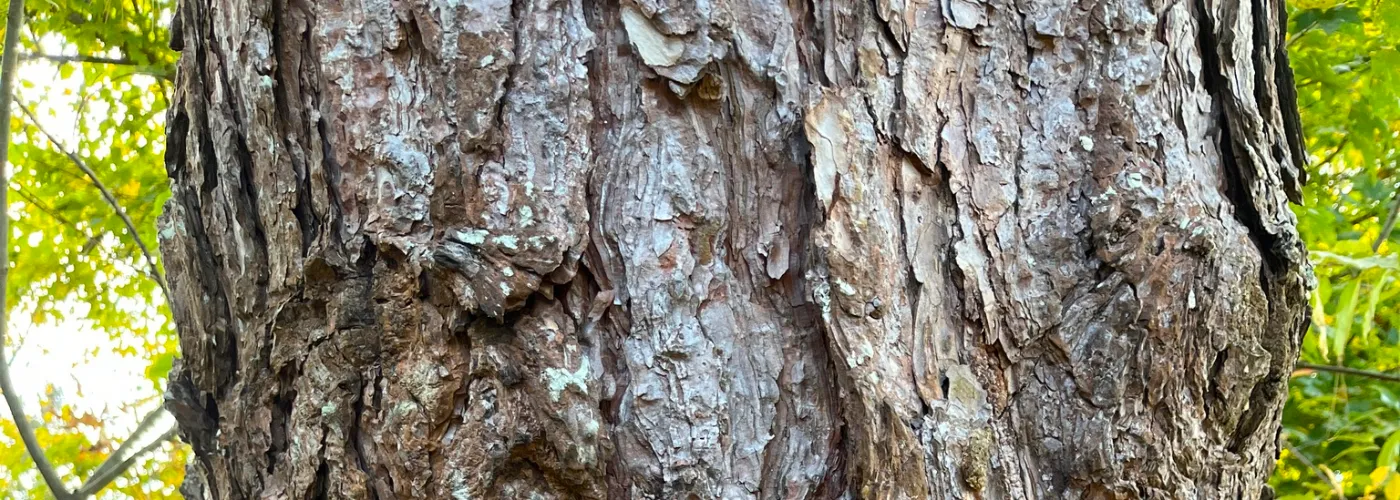
The needles are paired, dark, stiff and often twisted, 7–12 cm long, persisting three or four years, and the bark becomes dark grey and deeply fissured with age.
Against the other two pines you are likely to be offered: Japanese Red Pine (P. densiflora) is also two-needled, but the needles are finer and a brighter, softer green, and mature trunks flush orange-red in the upper canopy. Japanese White Pine (P. parviflora) is unmistakable — five needles to a bundle, blue-grey, and a much softer overall texture.
The quick check
Woolly new shoots and chalky white buds, needles in twos. If all three agree, it is a Black Pine. Five needles means White Pine; fine bright needles with orange upper bark means Red Pine.
The Three-Needle Question
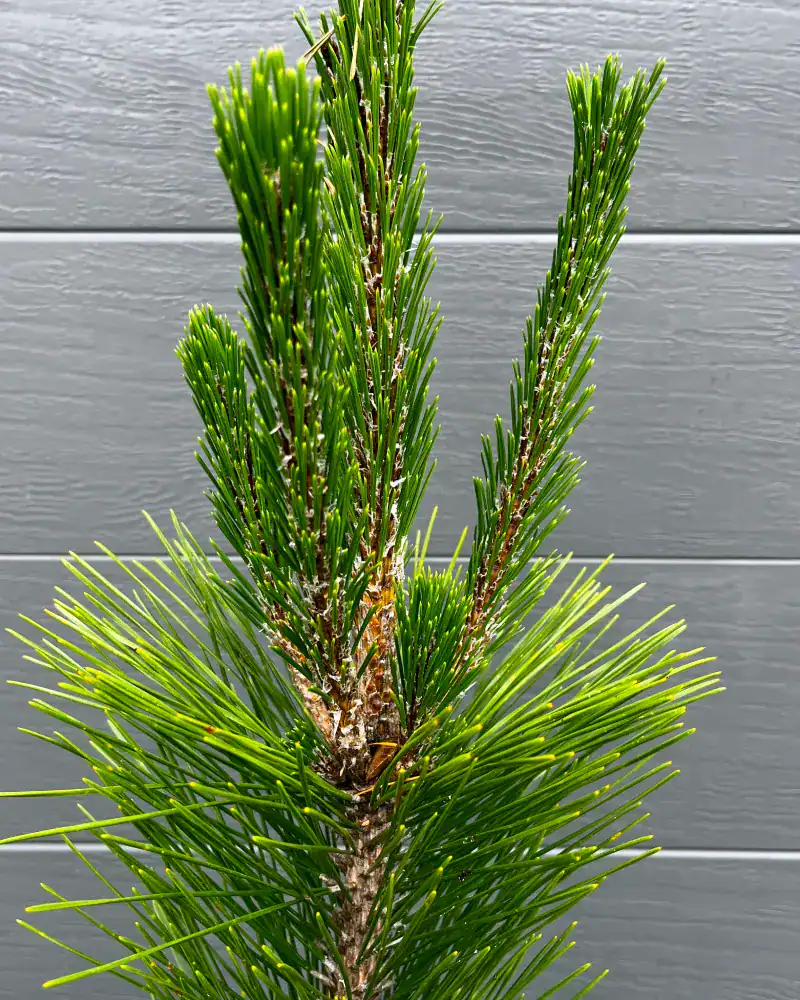
A customer wrote to me last season about a young Black Pine he had bought. Scattered through the upper crown, on the strongest shoots, were fascicles carrying three needles instead of two. He wanted to know whether he had been sold the wrong tree.
He had not, and the answer is more interesting than the question. Needle number is one of the standard characters used to identify pines, but it is not fixed. New Trees (Grimshaw & Bayton), via the International Dendrology Society, notes that the number of needles in a fascicle can be subject to environmental influences, and that fascicles around the apical bud of the lead shoot of vigorous young trees frequently carry more than the usual number for the species (Trees and Shrubs Online). The same source illustrates the point with a photograph of three-needle fascicles on the lead stem of a young Scots Pine — another strictly two-needled species.
The mechanism explains why they turn up where they do. A fascicle is not a cluster of leaves on a twig; it is an entire reduced shoot, and the needles it will carry are laid down as primordia in the bud during the previous season. Classic work on red pine established that the number of these dwarf-shoot primordia is governed by conditions in the middle of the preceding growing season, so one year’s growing conditions precondition the next year’s foliage (Garrett & Zahner, Ecology 1973). A seedling running hard, laying down primordia on a strong leader, occasionally lays down an extra one.
Two things follow. It is a marker of vigour, not of stress or of mislabelling — which is why it concentrates on the strongest, most actively extending growth rather than appearing at random. And it is not evidence of hybridity: the natural cross between Black and Red Pine, P. × densithunbergii, cannot introduce a third needle, because both parents are two-needled.
A note on what this is: the published sources above establish that off-count fascicles occur in pines generally and cluster on vigorous juvenile leaders. What I can add is only what I have seen here. Across my own seed-grown stock and my grower’s, the trait shows up in a minority of juvenile plants, sits in the upper crown, and diminishes as the plants settle out of their fastest growth. I have not tracked individual trees over enough years to call that a rule, and I am not going to dress up an observation as a finding. If you have a plant doing this, watch it rather than worrying about it — and if three-needle fascicles are still dominant on mature foliage years later, that is the point at which the identification is worth revisiting.
Seed-Grown or Grafted
This is the decision that determines what you can do with the plant, and it is worth understanding before you buy rather than afterwards.
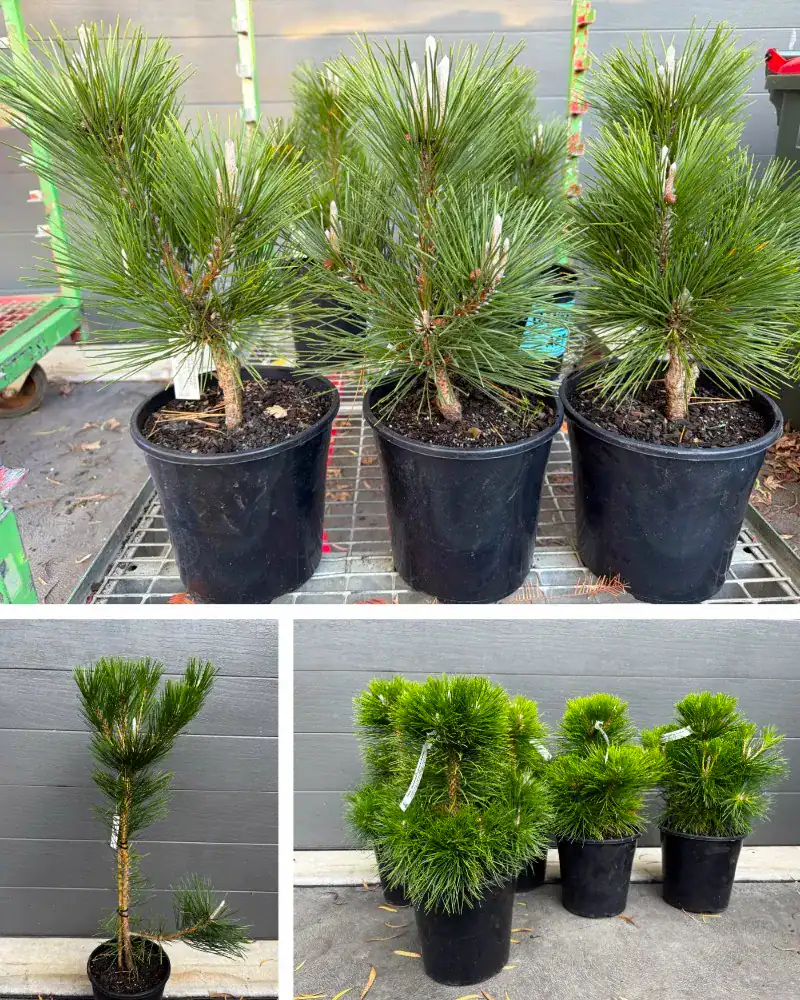
Seed-grown plants are genetically individual. No two are identical, vigour varies, and so does needle length, internode spacing and the natural inclination of the trunk. That variation is the reason the three-needle question above exists at all. For anyone developing material from the ground up it is an advantage rather than a defect: you are selecting from a population, and the plant you choose has traits nobody assigned to it. It also means you must actually look at the plant in front of you, because the label will not tell you what you are getting.
Grafted plants are the opposite proposition. Most named cultivars — ‘Kotobuki/Takara’, ‘Thunderhead’, ‘Kyokko Nishiki’ — are single clones, and the only way to reproduce one faithfully is to work a scion onto a rootstock, which for these is almost always seedling P. thunbergii. What you buy is predictable: the compact habit, the short needles, the branching character are already decided. You are buying a known quantity and, in effect, several years of somebody else’s propagation work. For a clonal cultivar, “seed-grown” is a contradiction in terms — seedlings of a clone are not that clone.
‘Yatsubusa’ is the exception, and it confuses people constantly. Yatsubusa (八房) is not the name of an individual plant at all — it is a Japanese descriptor meaning roughly “many buds”, applied to dwarf, densely multi-budding forms with very short internodes. Because it names a habit rather than a clone, it can legitimately arrive either way: as grafted material from a selected clone, or as seedlings grown on and selected to type, with anything that fails to express the habit discarded. Both are honestly sold as Yatsubusa. They are not the same product, and it is worth asking which one you are being offered.
My own preference, and it is only that: I handle both, and I favour the seed-grown Yatsubusa. In my stock it runs noticeably more robust than the grafted equivalent, with a tighter, more heavily candled form, and it carries no graft union at all — an unbroken trunk line from soil to apex. That is an observation across the plants that have passed through my hands rather than a controlled comparison, and a grower working from different seedling lines may well tell you something else.
The graft union is a permanent feature of the plant, not a flaw, but it is a design constraint: it sits where it sits, and a low, well-executed union gives you far more freedom later than a high one. Look at it before you buy.
Our grafted Japanese pines come from Coolwyn Nurseries at Monbulk in Victoria, who have been grafting them for decades and whose workmanship is the reason we buy from them rather than anyone else. Our seed-grown material is exactly what it says it is — variable, unselected except where a line is grown on and selected to type, and priced accordingly.
The Bud You Cannot See
There is a piece of pine anatomy that explains why Black Pine responds to hard treatment the way it does, and almost nobody mentions it.
Each fascicle — each bundle of needles — carries a minute dormant bud at its base, called an interfoliar bud. New Trees notes that these buds can usually only develop while the fascicle is young, less than a few months old, and typically do so after damage to the shoot beyond them; they are rarely noticed, but are described as vitally important in the close trimming carried out in bonsai (Trees and Shrubs Online).
Read that carefully and the entire logic of pine work falls out of it. Removing growth from the end of a shoot is what releases those buds; the reason it has to be done at the right moment is that the buds are only competent to respond while the fascicle is still young; and the reason back-budding happens where it does is that the buds are sitting at the base of every needle bundle, waiting. Black Pine is not simply a tough tree that tolerates being cut. It carries a distributed reserve of latent growing points, and the technique is built to trigger them.
Why this matters when you are choosing a plant
A plant with needles held close along the shoot has its latent buds close in too. A plant that has run hard with long bare stretches between fascicles has fewer options and they are further out. Short internodes are not an aesthetic preference — they are a measure of how much future the plant still has in it.
Decandling, and Why the Calendar You Read Online Is Wrong
Decandling — removing the spring candles so the tree pushes a second, smaller flush — is the technique Black Pine is famous for. I do not practise it and I am not going to instruct you in it. What I can do is fix the single most common error Australians make with it, which is a calendar error, and it is entirely mechanical.
Practically all the good written material on Black Pine is northern-hemisphere, and it gives dates. Those dates are anchored to the summer solstice. Bonsaify sets the baseline at around 20–21 June in the northern hemisphere and 21–22 December in the southern, and notes that the adjustment from there is climatic: decandle one to three weeks earlier in areas with cooler summers, one to three weeks later where summers are hot, with earlier work producing longer needles suited to larger trees and later work producing shorter needles for smaller ones (Bonsaify). Michael Hagedorn, writing from Oregon, puts the offset plainly: growers in the southern hemisphere will be doing this six months from when he is (Crataegus Bonsai).
So the rule is not a date at all. It is: find your solstice, then move off it according to how hot your summer runs. A grower in the Southern Highlands, where summers are mild, is working before late December. A grower in Brisbane is working well after it. A grower in Hobart is earlier again. The northern-hemisphere article you are reading is not wrong — it is just calibrated to somebody else’s July.
Jonas Dupuich makes the same point about latitude and climate and adds the discipline that actually resolves it: record the date you work, note how the tree responds, and adjust the following year (Bonsai Tonight). Nobody can give you your date. Your own notebook can, in about three years.
One qualifier that all of these practitioners share, and that matters more than timing: the technique is for healthy, established, vigorous trees in refinement. It is not something to do to a plant you bought this season. Young material is built up first; it is decandled years later, if at all.
Growing It in Australia
Black Pine is one of the easier Japanese species to keep here, and its tolerances are unusually wide. It wants full sun and will not thank you for shade. It prefers fertile, moist, well-drained ground but grows perfectly well on sand, and it is both salt-tolerant and drought-tolerant — it can be grown almost to the shoreline, which is precisely why it was used for dune reclamation in the first place (Oregon State University Landscape Plants). Hardiness runs to roughly USDA zone 6, which covers everything in Australia including the tablelands.
In a container the binding constraint is drainage, not water. Pines will sit wet and sulk long before they will suffer from being a little dry, and the standard bonsai and specimen mixes are open and gritty for exactly that reason. Our approach to media generally is set out in The Custodian’s Guide to Growing Media.
Get the mycorrhizae right
Pines form ectomycorrhizal associations — fungi that sheathe the root tip from outside. Most general-purpose inoculants sold in Australian garden centres are arbuscular (endo) products, formulated for the flowering plants that make up the bulk of the market. They are not wrong products; they are simply the wrong symbiosis for a pine, and applying one will do nothing at all. Check the label for ‘ecto’ before you buy.
Beyond that, the species asks very little. Sun, drainage, and patience.
Why Your Black Pine Was Grown Here
People occasionally ask why they cannot simply import a good Japanese pine. The answer is a microscopic worm.
Pine wilt nematode, Bursaphelenchus xylophilus, is a National Priority Plant Pest and is not present in Australia (PIRSA). The Commonwealth describes it as affecting firs, cedars, larches, spruces and especially pines; native to North America, since introduced to Japan, Korea, China, Taiwan, South Africa, Portugal and Spain; and spread chiefly by Monochamus sawyer beetles, several of which — including the Japanese pine sawyer — are not found here (DAFF).
P. thunbergii is among the more susceptible hosts, and in its native range the disease has done enormous damage to exactly the coastal stands this article opened with. Australia has stayed clear of it, and the rules that keep pine material out are the reason.
So every Japanese Black Pine you can legitimately buy in this country was grown in this country, from a lineage that has been here for years. That is not a limitation on the material available to you — the cultivars below are all propagated here — but it is the reason provenance is worth asking about. When you buy a pine, you are buying a place in a domestic chain of propagation, and it is reasonable to want to know where in that chain your plant sits. Ours are grown in Victoria and here in the Southern Highlands, and dispatched from Mittagong.
The Cultivars, and Why Some of Them Just Changed Name
Before the table, something worth explaining, because several of these names are new and regular buyers will notice.
Grafting preserves a genotype, but not perfectly, and not forever. Over long runs of vegetative propagation, small spontaneous changes arise in individual cells, and where one of those lands in a growing point it can populate a whole shoot and be carried forward into every plant propagated from it. Horticulture calls the visible ones bud sports, and they are not rare curiosities — they are one of the main sources of new fruit and ornamental cultivars (Foster & Aranzana, Horticulture Research 2018). The scale of it is easy to underestimate: at least 38 distinct bud sports have been recorded from the ‘Gala’ apple since its release in 1965, and 91 from ‘Fuji’ (Hiraoka et al., Plants 2023). One famous clone, dozens of descendants, each subtly its own thing.
Add to that the quieter effect of selection at the propagation bench — scion wood gets taken from the plants that look best, season after season — and a line propagated in one place for decades can end up meaningfully distinct from the same cultivar grown elsewhere. Not a different plant, exactly. A form of its own.
That is the story behind ‘Takara’. The material descends from ‘Kotobuki’, the long-established Japanese selection, and it has been grafted and regrafted in Australia for many years. Over that time the Australian line has drifted a little from its parent — enough that continuing to call it ‘Kotobuki’ had stopped being quite accurate. The new name recognises it as its own form rather than a copy of something grown on the other side of the world.
The others are more straightforward. Where several unrelated selections all carry the same nursery’s house name as a prefix, the labels tell you who raised them and nothing about the plants, and it gets more confusing as the list grows. And a descriptive name can outlive its usefulness: ‘Black Panda’ was previously sold under a name that referred to its tall, columnar shape, which caused no end of confusion with actual Christmas stock. It is a year-round specimen conifer and always was.
If you already own one of these
Nothing has changed about your plant. It is the same tree, from the same propagation line, as it was last season. Only the label is different. We are listing both names side by side and will keep doing so for a good while, so nobody loses track of what they bought.
| Cultivar | Previously sold as | Propagation | Character |
|---|---|---|---|
| ‘Takara’ | ‘Coolwyn Kotobuki’ | Grafted — Kotobuki-descended Australian line | Dwarf and upright, short needles, dense branching from young. A good first serious pine and an excellent container specimen. |
| ‘Little Osaka’ | ‘Coolwyn Bonsai’ | Grafted — single clone | Very compact and slow, tight upright habit. Small in scale from the outset rather than a plant you have to keep reducing. |
| ‘Black Panda’ | ‘Coolwyn Christmas Tree’ | Grafted — single clone | The larger, columnar form — tall and even with a strong central leader. A year-round specimen conifer. |
| ‘Thunderhead’ | — | Grafted — single clone | Compact and billowing, long dark needles and very prominent silvery-white spring candles. |
| ‘Kyokko Nishiki’ | — | Grafted — single clone | Corky, deeply textured bark developing early — a Black Pine, despite the name being frequently misapplied to White Pine. |
| Yatsubusa (八房) — grafted line | — | Grafted from a selected clone | Dwarf, densely multi-budding, very short internodes. Predictable and uniform, with a union at the base. |
| Yatsubusa (八房) — seed-grown line | — | Seedlings grown on and selected to type | Same dwarf multi-budding habit, some variation plant to plant, and no graft union — an unbroken trunk line from soil to apex. |
| Seed-grown species (unnamed) | — | Seed, unselected | Genetically individual. Variable vigour, needle length and trunk movement; no two alike. |
Note that Yatsubusa appears twice, and deliberately so — because the name describes a habit rather than an individual plant, both a grafted line and a seed-grown line can carry it honestly, so it is worth asking a seller which they are offering. Availability across all of these moves constantly and none is held in volume anywhere in Australia, so treat this as a guide to what exists rather than a stock list. We source on demand through our grower network and bring stock up as it becomes available. If you are after something specific, ask — it is usually possible, it simply takes a season.
Where to Actually Learn This
I said at the top that I would not teach you technique, and I meant it. But I am not going to leave you without an answer either, because the answer is genuinely good and it is cheaper than anything I could sell you.
Join a club. Australian bonsai clubs are volunteer-run, inexpensive, and full of people who have been growing Black Pine in your specific climate for thirty years — which means they have already solved the calendar problem described above for your postcode. Most run beginner workshops, most welcome visitors before you commit to membership, and most will let you bring a plant along and have someone look at it with you. There is no substitute for standing next to somebody while they work on a tree.
The national body is the Association of Australian Bonsai Clubs, which represents 58 member clubs across every state and both territories and maintains a directory searchable by location. That is the place to find your nearest. A few long-established starting points:
| State | Club |
|---|---|
| NSW | Bonsai Society of Australia — founded 1965, one of the oldest in the country |
| ACT | Canberra Bonsai Society — fifty years old, hosted the 2025 national convention |
| VIC | Bonsai Society of Victoria — workshops and demonstrations for beginners and experienced growers |
| QLD | Bonsai Society of Queensland — one of Australia’s largest; visitors welcome, no experience needed |
| TAS | Bonsai Society of Southern Tasmania |
For South Australia, Western Australia and the Northern Territory, the AABC directory above is the reliable route — there are active clubs in all three.
Choosing One
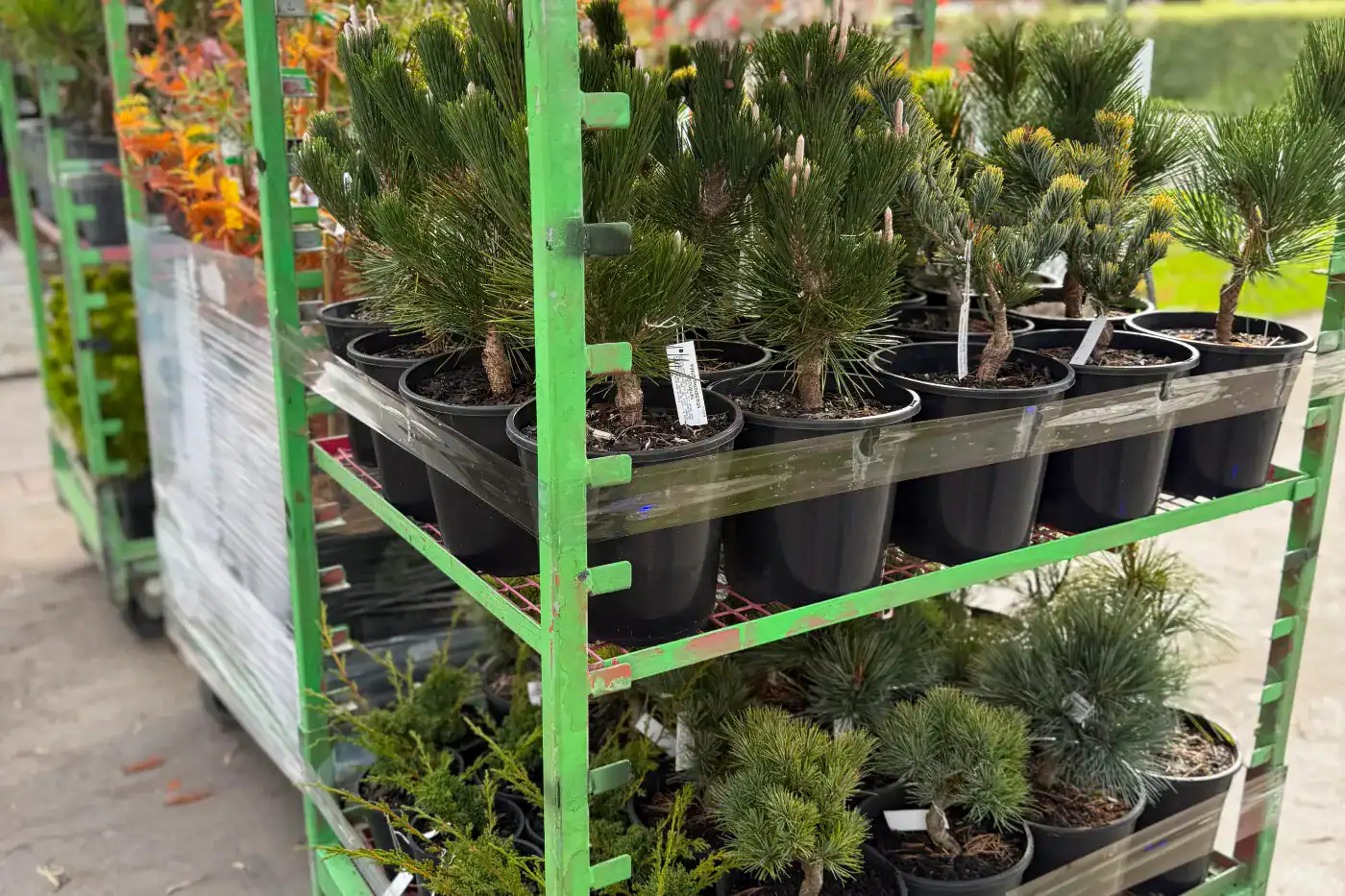
If you take one thing from all of the above, take this: look at the plant, not the label. Check the shoots are woolly and the buds are white. Look at where the needles sit along the stem and how much bare wood is between them, because that is where your options are. If it is grafted, find the union and decide whether you can live with where it is. And if there are a few three-needle fascicles up top, that is a tree growing hard, not a tree gone wrong.
We source Japanese Black Pine on demand through our grower network and bring stock up as it becomes available, rather than holding it in depth. If there is a cultivar you are after, or you want seed-grown material to select from, tell me what you are trying to build and I’ll tell you honestly whether I can get it and how long it will take.
Shannon grows rare and cool-climate species at Sequoia Valley Farms in Mittagong, in the New South Wales Southern Highlands. He is not a bonsai practitioner, and the good people listed above are.
Sources
Botanical and biosecurity material is cited to published dendrological and government sources. Technique and timing material is attributed to named practitioners and is theirs.
Grimshaw, J. & Bayton, R., New Trees — Pinus (genus), Trees and Shrubs Online, International Dendrology Society
Bean, W. J., Trees and Shrubs Hardy in the British Isles — Pinus thunbergii, Trees and Shrubs Online
The Gymnosperm Database — Pinus thunbergii
Foster, T. M. & Aranzana, M. J. (2018), Attention sports fans! The far-reaching contributions of bud sport mutants to horticulture and plant biology, Horticulture Research 5
Hiraoka, K. et al. (2023), Somatic Mutations in Fruit Trees: Causes, Detection Methods, and Molecular Mechanisms, Plants 12
Garrett, P. W. & Zahner, R. (1973), Fascicle Density and Needle Growth Responses of Red Pine to Water Supply Over Two Seasons, Ecology 54
Oregon State University, Landscape Plants — Pinus thunbergii
Australian Government Department of Agriculture, Fisheries and Forestry — Pine wilt nematode
PIRSA — Pine wilt nematode
Bonsaify — Guide to Decandling Japanese Black Pine Bonsai
Hagedorn, M., Time to Decandle your Black Pines, Crataegus Bonsai
Dupuich, J., Decandling black pine bonsai — an in-depth guide, Bonsai Tonight
Association of Australian Bonsai Clubs